
Version 1.0.0 · 31 August 2026
Melodex Studio 1.0
Melodex Studio 1.0 is the first version we call complete.
You describe music in words and get back a structured project with tracks, clips, notes, and sections, not a single audio file. Say what should change, hear it back, and keep going.
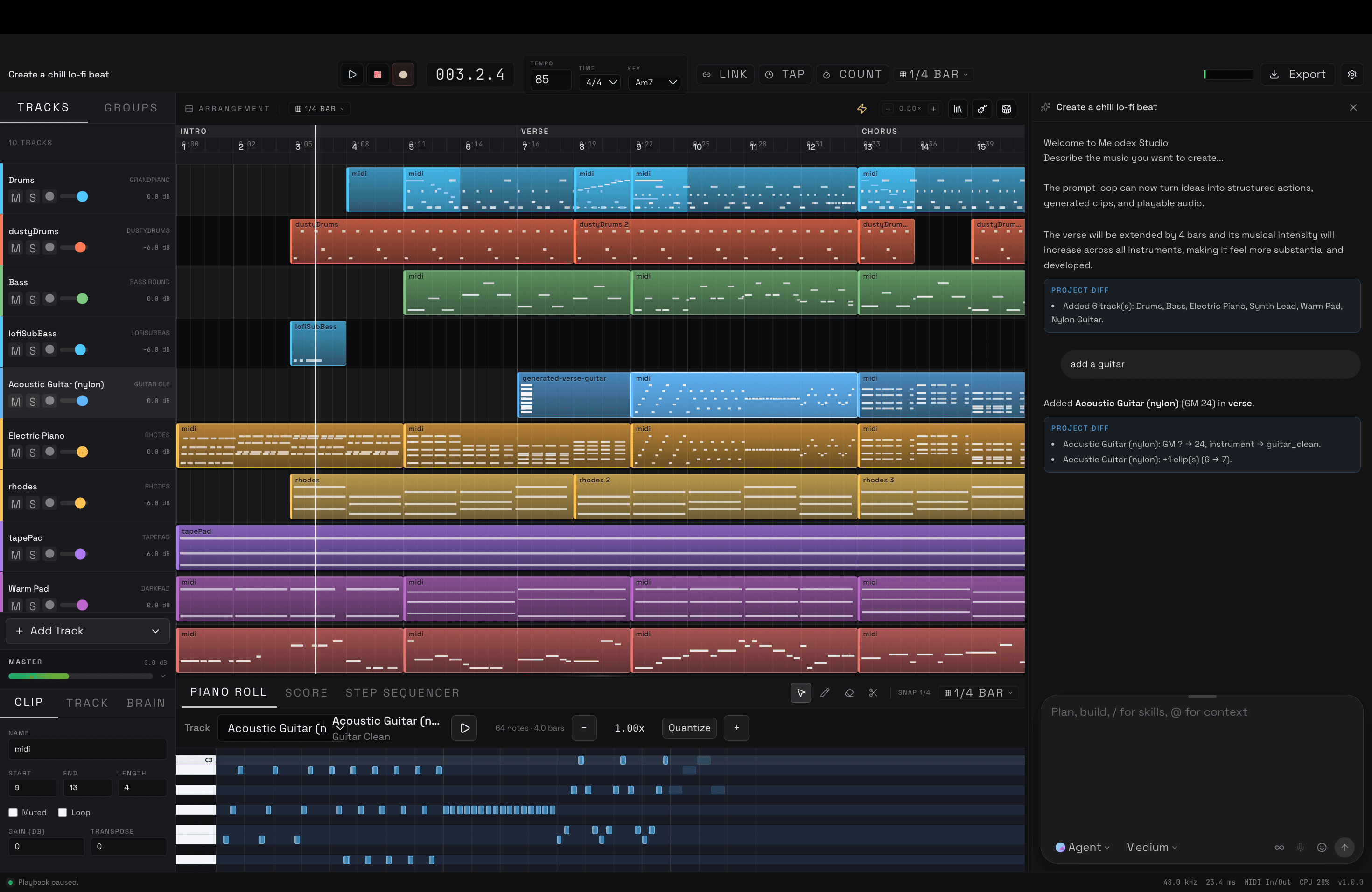
Generation
Start a full multitrack project from a prompt.
Name the genre, BPM, key, mood, instruments, and direction.
Arrangements come with drums, bass, harmony, melody, and effects in place.
Keep iterating on the same project in words. No need to start over.
Tansen
Tansen is the music model inside Melodex.
It works on the project itself, not on flat audio.
Edits stay aware of the harmony, rhythm, section, and instruments around them.
This is what every later model feature will build on.
Auto Notes
Finish an unfinished phrase in the piano roll from what is around it.
Suggestions follow the nearby notes, harmony, and rhythm.
Turn a half idea into something playable without entering every note by hand.
Melody
Ask for a melody from a prompt, or from the key, harmony, rhythm, mood, and section you already have.
It lands in the piano roll and stays editable.
Melodies live in the arrangement, not as loose audio clips.
Continue
Stretch a melody out from where it ends.
It keeps the feel, shape, and context of the original phrase.
Grow a short motif into a longer line: generate, listen, continue, edit.
Editing
Change music in words without replacing the whole project.
Point edits at a section: chorus, drop, verse, or one part.
Say things like:
- Make the chorus punchier.
- Make the melody more emotional.
- Add strings to the chorus.
- Make the drums less busy.
- Raise the energy of the drop.
Musical structure
The model follows key, chords, scale, tempo, meter, section, instruments, energy, and rhythm.
Chord, melody, motif, groove, and orchestration systems got a full pass.
Guitar and tabla now behave like themselves, not generic MIDI.
Studio
Multitrack projects with separate instrument tracks and MIDI clips.
Timeline with sections, snapping, zoom, and loop.
Piano roll and drum editing.
Volume, pan, mute, and solo per track.
The project file is what the model reads and writes, so nothing gets lost between you and it.
Playback
MIDI timing stays tight across tracks.
SoundFont playback for electronic and Indian classical instruments.
Handles tempo changes and long sessions better, with less memory on big projects.
Mix
Effects per track plus a master bus.
Model-assisted mix passes when you want a second opinion.
Lo-fi mode: vinyl crackle, tape warmth, pitch drift.
Nothing is destructive. You can always back out.
Import
Drop WAV and MP3 into a project.
Audio lines up to your project tempo.
BPM and key detection, audio-to-MIDI, and stem split for drums, bass, vocals, and other.
Recorded parts and generated parts can share one session.
Export
Mix down to WAV or MP3.
Stems per track.
Offline render when you want it faster than realtime.
Stems open in any major DAW.
Projects
Native `.musicproj` format.
Save, load, undo, redo, and version history.
Timeline settings stick around. Missing assets can be recovered.
Security
OAuth 2.0 with PKCE, plus magic-link fallback.
Stay logged in across devices.
The model checks its actions before touching your project.
Tougher project-file handling and cleaner errors around playback and render.
Desktop
Electron app for macOS and Windows.
Better multi-monitor and audio-device handling.
Fixed the annoying keyboard clashes. Timeline navigation is quicker.
Performance
Faster, more accurate note completion.
Quicker project load and timeline response.
Less memory on large sessions. Generation and render feel tighter.
Availability
This is the first version we consider done: a model that reads the project, a studio you can edit, and a file you can take somewhere else.
The question from day one was simple. What if making music worked like a good coding environment. You state the intent, the system makes the change, you keep going.
That is what is shipping today.