
Preface: A quick note before we start
I'm not going to pretend this is a big-company about page. There's no stock photo of a team on a rooftop. It's mostly me, building the thing I wish existed when my friends tried to make music and quit.
If you've ever had a melody stuck in your head and no way to get it out, or opened a DAW and felt like you walked into a cockpit, this page is for you. I'll keep it short.
Part One: The problem as I see it
DAWs are amazing and exhausting. Ableton, Logic, FL, Pro Tools. They put a whole studio on a laptop, which was a miracle. But they were designed to copy a physical studio. Tape tracks, mixer consoles, aux sends. That made sense in 1992 when the users were engineers who already knew that world.
Almost nobody making music today has worked in a physical studio. They're in a bedroom or a dorm with a laptop. They have an idea, not a mental model of signal chains.
So the first session goes like this. You open the app, you need to learn tracks, MIDI vs audio, plugins, EQ, compression, synthesis, music theory, arrangement, mixing, mastering. Each one is weeks to learn. Pros have spent a decade on it, and the tools are built for them. Not for you.
I've watched good songwriters give up here. Not because they lacked ideas, but because the software asked them to learn the machinery before they could hear anything they liked.
That gap bothers me. Music is old. Older than writing. For most of history you just needed a body to make it. Now you need money, time, training, or all three. The people locked out aren't less musical. They just didn't get the same access.
And when the door is too hard to open, people settle. They license a stock loop that kind of fits. They drag preset beats together. They watch tutorials for a month and stall around compression. Or they just keep humming the idea and never make it. That last one happens a lot more than we admit.
Part Two: Why the easy fixes didn't stick
We tried simpler apps. GarageBand, BandLab, Soundtrap. They're friendlier, and GarageBand got millions of people to touch a multitrack for the first time. But it's still the same model with fewer buttons showing. The moment you want something specific, the full complexity comes back, and that feels worse because you thought you were past it.
Then came loops and sample packs. Splice, loop libraries. You can build something that sounds decent in fifteen minutes. The problem is the ceiling is the library. You're picking from what exists instead of making what you hear. It rarely feels fully yours, and clearing samples is its own headache.
Then AI generation. Type a prompt, get a song. The quality jump was real. But you get back a single stereo file. Love the drums, hate the bass? Start over. Want a bigger chorus? Start over. You can't reach in and change one thing.
That last part is why producers bounced off it fast. Making music is the loop. Make something, listen, change one thing, listen again. A tool that gives you a finished file skips the loop instead of helping with it. And authorship gets weird. If the model wrote the melody, chords, and arrangement, did you make that song? For background music, maybe you don't care. For expression, you do.
Part Three: What Melodex actually is
I started Melodex with a different question. Not what can AI generate, but what does someone with an idea actually need?
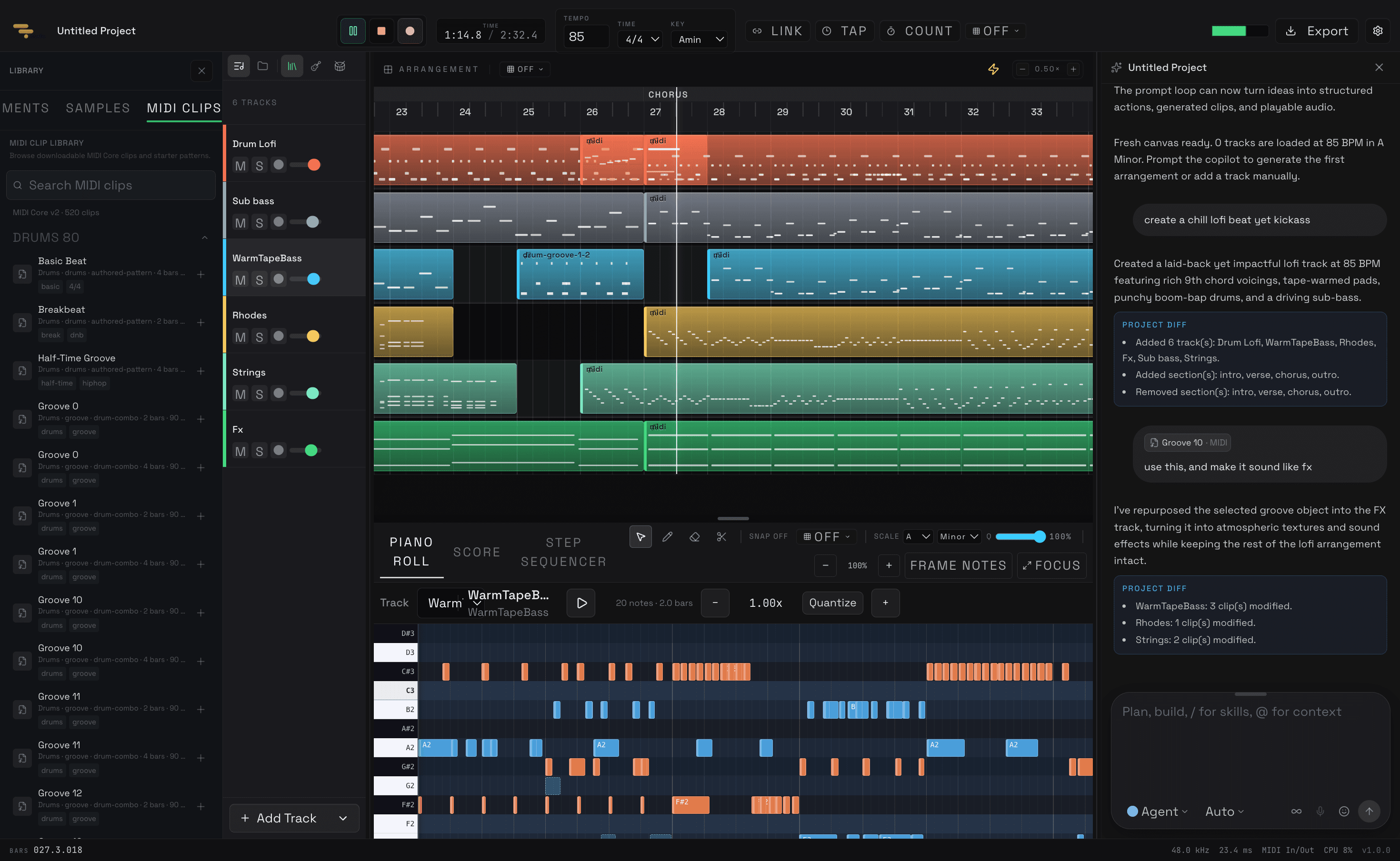
They need agency. A way to make choices and hear them. So the core unit in Melodex isn't an audio file. It's a session. Sections across the top, intro, verse, chorus, bridge. Instruments down the side, drums, bass, chords, lead. Each cell has real notes you can see and change.
You start by describing what you want. "Dark trap beat, 140 BPM" or a longer note about the feeling you're going for. You get back a full starting session in under a minute. Not a waveform. Tracks.
Then you edit in words, the way you'd tell a musician friend. "The verse feels too comfortable, add some tension." "Make the snare crunchier but keep the bass where it is." Melodex changes that part and leaves the rest alone. You listen, you push back, you iterate. That back and forth is the product.
People ask what AI-native means. For us it just means the AI isn't a side panel bolted onto a normal DAW. The session is structured so language can work on it. You can't pull the AI out and still have an app. The words build the music, refine it, reshape it.
And to be clear, generating is the smallest part. You generate once at the start. Everything after that is editing. Listening, describing a change, hearing it back. That's where your taste lives. That's where the song becomes yours.
The Cursor comparison comes up a lot, and it's fair up to a point. Cursor didn't replace coding. It let you describe intent, review the diff, keep authorship. We want the same for music. The difference is music has no test suite. "Sounds right" is subjective. So our job is harder in a way. We have to understand feeling, not just spec. "Melancholy lo-fi beat" means something different in hip-hop than in ambient. We're still getting better at that, honestly.
Part Four: What I believe
I don't think creativity is rare. Kids make up songs before they know theory. Everyone hums. The impulse is everywhere. What's rare is a path from impulse to finished thing.
I also think tools change what you make, not just how fast you make it. A piano song comes out different from a guitar song. A loop-based DAW pulls you toward loop-shaped music. A tool where you describe intent and iterate pulls you toward something else. I'm curious what that music sounds like, especially from people who never got to make any before.
On AI, my view is simple. It should give you more control, not less. Not replace musicians. There is no automating expression. The AI gives you material, you bring judgment. What to keep, what to cut, when it's done. That last call is always yours.
Part Five: Where this goes
Right now all my focus is on the core studio. Describe music, get an editable session, iterate fast. It has to be genuinely good, not just impressive in a demo. We'll know it's working when people stop talking about Melodex and start showing off songs they made with it. We're getting close.
Later, I want instruments and sounds to live inside the session without plugin hell. Type "add a Wurlitzer to the verse" and it's there. I want real collaboration, two people in the same session at the same time, no bouncing files back and forth. And long term, I want this to help with all the places that need music and can't hire a composer every time. Games, podcasts, videos. Described and edited by the people who need it.
But none of that matters if the foundation is weak. So that's where I am. Making the loop tight.
Conclusion: Come make something
I'm Supriyo. I'm a full-stack engineer, not a traditionally trained musician, which is probably why this problem stuck with me. I kept watching non-engineers hit walls in software built by engineers, and music felt like the clearest example. Everyone has music in them. Almost no one has a way out for it.
Melodex is small right now. I'm building carefully, with people who care about creative tools and have felt this frustration themselves. We're standing on a lot of work by musicians, producers, and researchers who came before us. I'm grateful for that.
If you read this far, try it. Bring a half-formed idea. Type it in. Change three things. Keep what you like.
Come make music. The door is open.