
Essays
Why Editable Music Matters More Than Better AI Generation
Better generation gets you to a first version faster. Editable music gets you to something you actually want to keep.
By Melodex Studio · Sep 2026
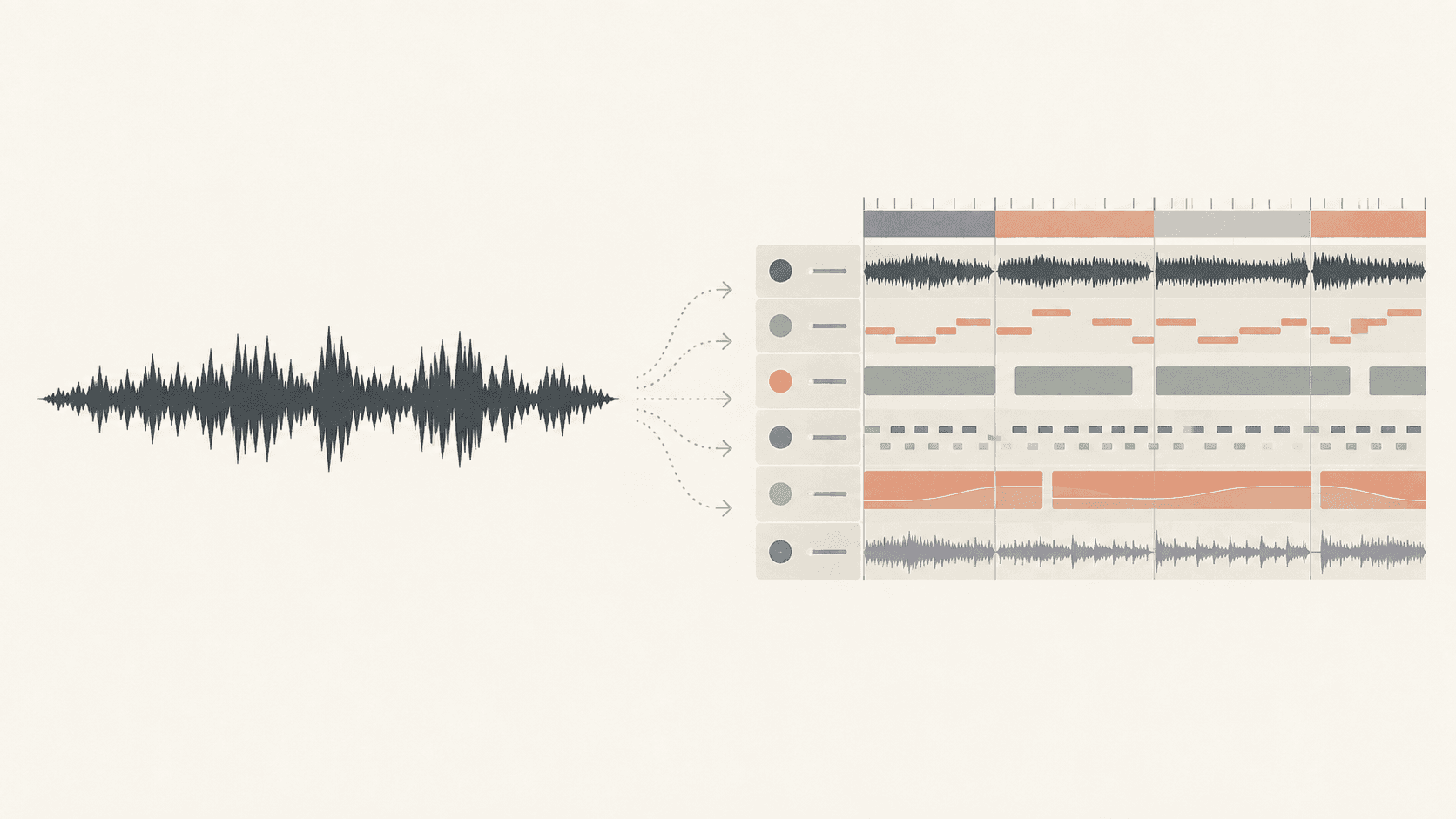
AI music has become very good at producing something impressive in seconds.
That is a real achievement. It is also not the same thing as making something useful.
The gap usually appears about thirty seconds after the first listen. The track starts well. The verse has a melody worth keeping. The drums are close. Then the chorus arrives and it is too crowded, or the bass enters too early, or a piano part keeps stepping on the hook.
At that point, the interesting question is no longer, “Can a model generate music?”
It is: “Can I keep the good part and change the part that is wrong?”
That is where AI music generation and music production start to look like different jobs.
A first draft is not the work
Generation solves the blank page unusually well. Give a system a mood, a tempo, a few instruments, and some direction, and it can give you a first pass before you have time to make coffee.
For a lot of uses, that may be enough. If you need a finished piece of audio quickly and do not expect to pull it apart, a text-to-audio generator is a useful tool. There is no point pretending otherwise.
But production begins when you react to what you hear.
You keep the verse, but rewrite the chorus. You preserve the melody and change the harmony under it. You simplify the drums. You make the bass wait eight bars. You take one instrument out. You make the final chorus more energetic without turning the first chorus into the same thing.
None of those requests asks for another song. They ask for judgment to be applied to this song.
This is the part that gets lost when AI music is judged only by the quality of a single generation. A better first draft is valuable. It still does not give you a production workflow.
The problem with the audio blob
A finished stereo file is a useful delivery format. It is a terrible working format.
Once the drums, bass, chords, melody, effects, and arrangement have been rendered into one waveform, most of the decisions that made the song are no longer directly available. You can hear a snare. You cannot simply reach into the file and make only that snare less busy. You can hear the harmony. You cannot ask the waveform to keep the melody and replace the chords underneath it.
Audio tools can cut, stretch, process, and separate a mix into rough stems. Those are valuable techniques. But they are working backwards from the result. They are trying to recover structure that was explicit before the song was flattened.
This is why “generate again” often feels so unsatisfying. A new pass may fix the weak chorus, but it can also replace the verse you liked, alter the groove, move the hook, or change the sound of the whole piece. You did not ask for a new roll of the dice. You asked for a revision.
Producers do not experience a song as one indivisible object. They hear sections, tracks, motifs, transitions, harmony, groove, and energy. They notice that the pre-chorus is not earning the chorus, or that the hi-hats are making a quiet verse feel impatient. They think, “change this,” not, “discard everything.”
An audio blob hides the handles they need.
Better generation does not create those handles
It is tempting to assume this is a temporary quality problem. If the models get better, perhaps the control problem disappears too.
I do not think it does.
A system can become much better at making a convincing song from a prompt and still be unable to preserve bars 1 through 32 exactly while changing the harmony in bars 33 through 48. Those are different capabilities. One is about producing a plausible whole. The other is about understanding the parts of an existing whole, respecting constraints, and changing only what was requested.
“Make the chorus punchier, but keep the verse exactly the same” sounds simple because a person can say it in one sentence. Musically, it contains several instructions.
The system needs to know where the chorus begins and ends. It needs to understand what “punchier” could mean in the context of this arrangement. Maybe the kick needs more weight. Maybe the chord rhythm should tighten. Maybe one extra percussion part is enough. It also needs to treat the verse as a constraint, not as loose inspiration.
Most importantly, it should make a change you can inspect, keep, refine, or undo.
That is not text to audio. It is intent to editable musical changes.
What editable music actually means
Editable music is not just a file with a few stems beside it. Stems help because they let you rebalance or remove broad layers. But meaningful editing goes further.
It means the project still knows that it has an intro, a verse, and a chorus. It knows which notes belong to the bass track and which belong to the piano. It knows the tempo, key, timing, velocity, and where clips sit in the arrangement. The rendered audio is something the project can produce again, not the only surviving version of the idea.
That structure creates useful boundaries.
If you ask for less busy drums in the intro, the edit can be scoped to the drum material in that section. If you want a warmer instrument on an existing part, the notes can stay in place while the sound changes. If the bass should enter later, the arrangement can move or remove the relevant clip without inventing a new melody everywhere else.
MIDI matters here because notes remain notes. Their pitch, timing, length, and velocity can be changed directly. The piano roll is still there when words are too vague. Natural language can handle the broad intention; direct editing can handle the two notes you want a little earlier.
The point is not to replace precise tools with prompts. It is to let both ways of working touch the same project.
A project, not an answer
This is the reason we have built Melodex as an AI-native DAW, rather than as a prompt box that ends at an audio file.
Melodex generates a multitrack arrangement with editable MIDI material. The project keeps its tracks and sections, so a follow-up request can be interpreted against the thing already on the timeline. The AI's job is to understand which part you mean and what kind of musical operation you are asking for. The project provides the boundaries that make that operation specific.
That does not make every edit automatically correct. “More energetic” is still subjective. In one song it may mean denser drums; in another it may mean a wider harmony or a shorter gap before the downbeat. You still have to listen. You still have to decide.
But when the result is wrong, you are not forced back to zero. You can undo it, rephrase it, edit the MIDI yourself, or export the MIDI and stems to the DAW you already use.
The important shift is that the generated result is not treated as sacred. It is material.
We went deeper into the model and project architecture in our article about Tansen. The short version is that interpreting a request, making a musical plan, and applying a scoped change are more useful to us than asking one black box to remake the entire song. The same idea also explains how Melodex differs from a traditional DAW: language is an additional way into the project, not a substitute for tracks, clips, notes, and arrangement.
From getting a result to working on a result
The most interesting AI tools do not simply hand over an answer. They let you continue.
In music, continuing is the work. The first version gives you something to react to. Then taste takes over: this part stays, that part goes, this transition needs another bar, the bass is doing too much, the hook should return once more before the ending.
An AI music production tool should be good at that conversation. Not only the conversation in the chat panel, but the musical conversation between an idea and each revision of it.
Generation speed still matters. Generation quality matters too. A weak starting point is not rescued by perfect editability.
But better generation mainly gets you to a first version faster. Editable music gets you from the first version to the one you actually meant.
The goal is not simply to give someone a song.
It is to help them make the song they want to keep.
Want to try the workflow? Open Melodex Studio and start with a rough idea. Keep what works. Change what does not.